Wednesday, September 28, 2011

The Gift of Receiving

Our most recent post comes from the fingers of Leslie!  Enjoy!
------------------------------------------------------------------

I have always heard that it is better to give than to receive.  After a year in Uganda, I am seeing that it is equally important to receive as to give because without receiving, there can be no gift.

One of the things I love about Ugandans is that they receive without complaint or condition.  Imagine serving afternoon tea to a guest on your front porch.  In Uganda, you would never hear:

  • "Do you have any  soy milk?"
  • "Sorry, I'm on a no-cookie diet this week."
  • "I really shouldn't have black tea this late in the day; do you have any herbal tea?"
  • "I prefer honey, not sugar... Equal is even better."
  • "Is this peanut butter organic?"
  • "I can't sit for tea, I'm sorry I have to run... maybe next time?
  • "I only eat whole grain bread" or "That butter is too high cholesterol for me!
  • "I'll just have water, thanks."

Washing hands before tea
Instead, what you would find is a gracious  guest who will wait for you to sit with them, then give thanks in prayer for whatever is being served and for the gift of your time & company.  They will drink what is in their cup and joyfully eat what is on their plate -- all of it.  They will not refuse what is served or request anything that is not being served.  They  receive a gift without question or complaint.

I can tell you that it brings a lot of joy and simplicity to life -- to gratefully take what is given and to be thankful in the moment.  I personally have a lot to learn in this department. I have flat out rejected gifts from family & friends, and in doing so, I have robbed the giver of the joy of giving.  How wonderful it is to give a gift that comes from the love & generosity in your heart and to have it received with that same love & generosity. It doesn't matter the size or importance of the gift. What matters is the love that is extended & received between the giver & the recipient.

Another example  that impacted me recently was when I had collected some odds & ends of worn out clothing the kids had outgrown, including one brown shoe -- there was only one because Jesse had lost the other shoe at the Rwandan border...still not sure how that happened exactly.  ( I have learned not to throw anything like this out with the trash because it will be sorted and pulled out of the trash anyway. It's not trash; it's just gently used;)  So, after I put everything in a bag, I took it over to my neighbor because there isn't a Goodwill store nearby and I didn't know what to do with the items.  When she answered the door, I explained that not all of the clothes were in good shape, and that there was also a boy's shoe without a match.  She smiled and took the bag and said, "Thank you so much, I'm sure we will find a good home for everything, even the shoe."

As I walked back home, I realized how quietly profound her gracious reception of me and my bag of throw away items had been.  She could have said, "Oh, thanks, but no thanks.... I don't want your used clothing. What can I possibly do with these things?"  or, "Sure, I'll take the bag of clothes, but not the shoe.  Who will want only one shoe?"  Of course a bag of second hand clothes is hardly a wonderful gift, but it did start me thinking about giving and receiving and how I felt joy when my neighbor received me and did not reject my small contribution.

So, little by little, I am trying to make an effort to be a better receiver, to say, "yes" when someone offers -- even if what is on offer doesn't fit my need or my schedule or my diet or my sense of fashion. What harm is there in receiving a gift with a grateful heart and then deciding what to do with it later?  So what if dried apricots are not your favorite snack or if lavender is not a flattering color on you, or if the stuffed bear someone is giving your kid is missing an eye and will definitely need to be washed?  I'm trying to remember to smile and say "thank you," and to enjoy the moment and the love & friendship that is being offered.  I have Ugandans to thank for that!


Leslie receiving lunch from Sharon, one of our workers and friends.

Wednesday, July 27, 2011

July Snapshots

Whoa.  July has zipped along!  It has been a fast and full month.  I've been teaching (and loving it) the books of Hebrews and 1 Timothy, and trying to step up my assistance with technology at the school.  (Regarding the latter, I've been updating the BBUC website -- take a look:  bbuc.ucu.ac.ug)  The older three kids are nearly through their second term at their school Aine'Mbabazi (exams around the corner).  Julia continues to astound and amuse with her rapid intellectual and physical growth.  Leslie continues to shape our house into a home in spite of frequent power outs and almost an entire month without running water -- in the dry season!


Dry Kabale Town
The dry season is not quite what we expected.  I, at least, envisioned hot days and nights with searing dusty winds blowing across the hills.  I got the dusty part right!  The roads and paths swirl with dust raised by tramping feet, blowing winds, and various kinds of traffic.  People frequently get sick during this time because of breathing in the dust.  White shirts are not advised (although somehow the Ugandans still walk across town and sit in church and school with shoes, clothes, and faces looking clean and bright!  How do they do it?!), and shoes end up with a reddish-brown hue regardless of the color they had when you first stepped off the porch.

The mornings and nights, however, are quite cool, and sometimes even cold!  The sun is intense from late morning through early evening, but the breezes are still cool, and shade or cloud cover is quite comfortable. The beauty of Kabale continues to encourage us.

One jerry can of water weighs about 40lbs.
Protase carries two at a time.
Access to water is definitely a problem in this season.  The absence of rain coupled with regular power outs (power is required for pumping water to the town and up our hill) and frequent problems with water pipes results in a serious water shortage for the whole community.  We ourselves have been without running water for almost a month, and our rain collector has been dry for weeks.  This means our worker and friend Protase joins the stream of people trudging up and down the hill with heavy jerry cans of water.  I can't even begin to estimate how many gallons of water he has hauled for us.  Oy!  We would be in dire straights without him.  And inside the house it means carrying bowls and buckets of water to the kitchen and bathroom for cleaning dishes and bodies and for flushing toilets.

Here are a few snapshots of some of the ways we've spent our time this July (remember you can click on them to see a larger version):

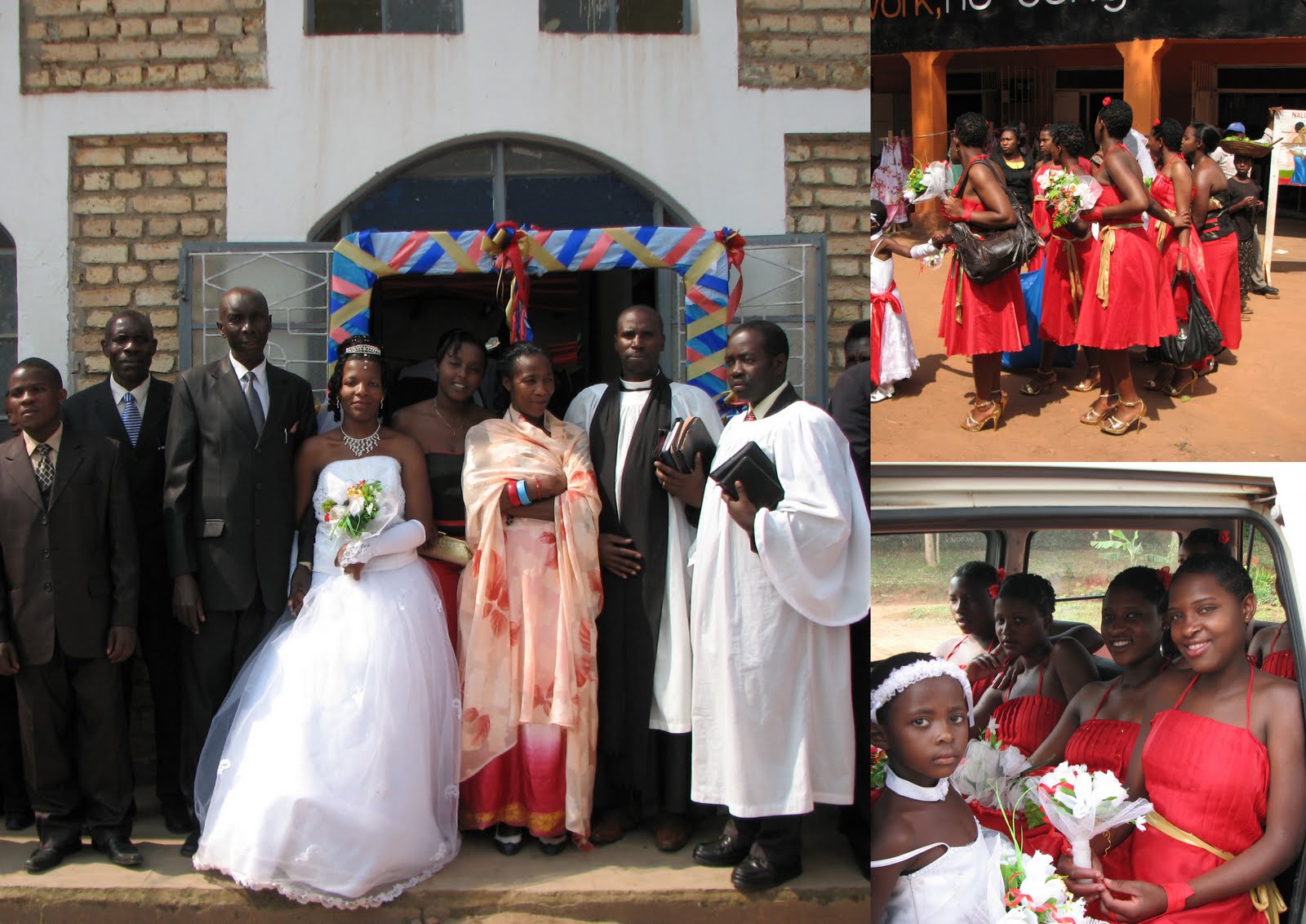
Our neighbour and head of security for BBUC, Benon, married, and I had the honour of being the chauffeur for the bridesmaids.  I loved the stark contrast of their fancy dresses and shoes against the backdrop of Kabale buildings and roads. The wedding itself was very much in the western (Anglican) tradition. The "Give Away," which happens the day before, preserves much more of the tribal culture, and is wonderfully joyful.


July is a celebratory month!  Micah (one of our teammates) had his birthday on July 2, America had her birthday on July 4, Jesse had his birthday on July 10, and we had our anniversary on July 11. The 4th of July was a fun time -- there was something special about remembering the history of our home country while being so far away.  In addition to hamburgers and attempts at fireworks, we also spent time singing, reviewing our constitution and the founding values of our nation, and re-learning how to play baseball!


Jesse turned 11 this year! This guy is growing in humour, intelligence, strength, and good looks. To celebrate, Jesse, Dr. Aaron, Micah and I spent a night on a local island called Bushara. We explored the island, stayed up late watching Legend of the Guardians, canoed out to Punishment Island, swung on rope swings and dropped into the (very) cold lake, and had a devotional and discussion about manhood on the dock at sunrise.  A highlight was the presentation of a flag designed by Jesse and Micah, and brought into existence by Jesse's grandma & grandpa.  (More about that on the kids' blog in a few days.) Another personal highlight for me was getting extended with with Aaron. On the actual Day, we celebrated with the Morrows and a friend named Gracious, eating chicken tacos & chocolate cake on the front porch.
Just this week, BBUC has been celebrating the life of one of their late lecturers, Prof. Joy Kyamunyogonya.  She was the Dean of the Social Work department, and apparently had a passion for cleanliness and concern for the least of those in the community.  In honor of her and in living out BBUC's motto of "Go and Tell Them," BBUC is spending the week imitating these ideals.  On Monday, we marched down Rugarama Hill and spent the morning picking up trash in Kabale.  This is a rare community service in this country, and Kabale is in such need of it! Yesterday we spent the Tuesday chapel hour worshipping God by cleaning up our own campus.  The remainder of this week will be spent visiting local hospitals, the prison, and other communities in need.  Pictured in the centre, by the way, is our Principal, Rev. Prof. Manuel Muranga -- he leads the way in all these events.


Tuesday, June 28, 2011

Village Visits


When we first arrived in Kabale, I would often ask a student or fellow lecturer, "So, where is your home?"  What I meant by the question was, "Where are you currently living?"  Almost invariably the person would gesture toward the distance and reply, "I stay in Kabale, but my home is...," and then would come the name and description of a district and village somewhere many kilometres away.  I quickly learned that the structures where people live here in Kabale -- whether it's a staff house, a hostel, a dorm, or a place in town -- is simply the place where they stay.  "Home" is where they are from, where their family is, where their land is, regardless of how long it has been since they last visited that place.

Here's a similar insight: Back in May our team joined Global Teams missionaries from all over East Africa for a retreat in Kenya.  The retreat was organized by GT's Missionary Caregivers, a group of women lovingly dedicated to pursuing our health and well-being.  The first few days of the retreat we
Kabungo Parish near Bunyonyi. Rev. Hannington's son, Golden,
is a student at BBUC
were with other North American missionaries serving in East Africa, and we spent time studying Scripture, listening to God and to each other. The second part of the retreat about 30 East and Central Africans joined us.  They are GT missionaries as well, with amazing stories of how they are reaching unreached people groups in their areas.  At one point during this part of the retreat, we had a session on cultural differences.  I asked the people in my group, "What does friendship mean in your culture?  How do you know whether someone is a good friend?"  One of the answers that received many nods and vocalizations of affirmation was, "A good friend is one who knows my family.  I mean, this is one who has traveled to my village and met my mother and my father and my sisters and my brothers and my relatives.  One who has been to my home."

So it's not a surprise that we've begun visiting people's homes.  On a Saturday or a Sunday, we pile into our white van and say a prayer.  Then we navigate our way down our hill to the main road, and drive to the local market.  We learned early on that bringing a gift is important to being a good guest, and bringing a branch loaded with matoke (green bananas) is one of the best gifts. Normally we then pick up a guide along the way, the host himself or a friend of the host, who directs us to the turnoff.  Then we bump (and, if it's raining, slide) across red dirt (or mud) roads in between, over, or around hills, past banana plantations and fields of sorgum or beans, through village markets, past countless pedestrians trudging to or from someplace we'll never know.  When we at last reach our destination (sometimes after 30 minutes of driving, sometimes after 6 or 7 hours of driving), we are always warmly welcomed by our host.

Typically, we all sit down for a cup of tea before anything else begins.  Even if a church service where I'm to preach has begun (we can hear the drums beating calling the people to worship), we
must sit down for tea.  First, a child of the host brings water warmed in a teapot and soap, and pours the water over our hands as we wash off the dirt of the road.  Then we enter the house, and sit (or squeeze) around around a table where the tea awaits.  Sometimes there is English tea (water and black tea), African tea (milk and chai), coffee (always a tin of instant Nescafe), sugar, milk, bananas, bread, honey, and g-nuts (peanuts).  Sometimes there is just African tea and a few pieces of bread.  Always there is graciousness and gratefulness, and time to pray and give and receive welcome.

Then the events of the day follow.  If it's a Sunday, all of us are brought to the front of the congregation to sit in full view of the people.  It is a long service of worshipping, singing, preaching (most often me through a translator), more singing, dancing (one of our favorite parts), and communion.  Another one of my favorite parts is the offering.  When the offering basket is brought to the front after being among the people, amid the coins and few bills you will often see a bag of eggs, a small collection of fruit, or other agricultural gifts from folks who did not have money to bring.  I have even seen a goat led to the front and tied to the chancel during the offertory!  Before the service is over, they will auction these gifts off to the congregants, and the money will go to the church, and the food item to the person who bought it.  Often that person will turn around and give what she has bought to the priest or to the visitors.

One other part I love is when I participate in giving communion to the people.  I get to see and touch
these dark, rough, holy hands of people who are so different from me, yet who are my brothers and sisters coming with faith to receive from the One who saves and unites us.  "The body and blood of our Lord Jesus Christ keep and preserve you and you and you and you...unto eternal life."  Old, withered faces with bright eyes; young, strong faces mildly amused at this muzungu priest; tired, sad eyes that won't meet mine; friendly, hopeful faces ready to receive; unreadable faces that stare straight ahead.  The family we are just barely coming to know and love.

After the service comes lunch.  There must be lunch!  Don't even try to excuse yourself from it!  Squeeze in there and be ready to pile your plate high with matoke, "Irish" potatoes, sweet potatoes, goat, beef and/or chicken cooked in a wonderful broth, rice, greens, rolls, liver, intestines, and (once) rabbit.  After you have eaten it all (mostly in silence), be ready for the fruit dessert -- the freshest pineapple, banana, passion fruit and watermelon ever to pass your lips.  Then comes obushera -- this strong, mildly fermented drink that few white people can stomach, but that all Bakiga insist is wonderful and very good for digestion.  Then comes...yes, more tea.

Finally, full of food and welcome, we totter back to the van, often carrying a bag of beans or potatos or vegetables as a parting gift.  We clamber into the van, and begin the journey home.

These visits are both hard and wonderful.  Hard -- we're still learning cultural cues, struggling with
communication due to our lack of Rukiga (the local language) and our hosts' differing uses of English, adapting to new physical circumstances, and eating unusual food.  There is also the challenge of being a young family in these situations; naps are missed, children get tired, they get hungry (although we're impressed with what great eaters of Ugandan food they have become!), places that feel safe to our hosts sometimes seem dangerous to us; I get a lot of attention and am often involved with services or interacting with people while Leslie is left alone to care for the kids.

Wonderful -- the hospitality is unceasing.  Our hosts and their community consistently receive us with genuine excitement, unending hand-shakes, hugs, gifts, kind words, and food.  We learn more of Bakiga culture in a few hours in the village than days in our house on our hill above town.  We get to see a way of life that reveals both the beauty and challenge of the simpler, poorer life away from town.  The geographical beauty is often stunning.  We experience the humbling joy of being hosted by people who know how to love a lot with so very little.  And we become friends with the people we're learning to love, knowing them in their home.


(Here are a few more photos from our visit to Canon Jovahn's home, pictured above, Deputy Principal of BBUC.  By the way -- in case you don't know, you can click on any of the pictures in our blog and see a larger, clearer version.)


Monday, June 20, 2011

Caring and Careful Wisdom

As you read in my previous post, obviously I enjoyed the importance of tea in the meeting of the Scholarship Committee.  I was even more impressed by the caring and careful wisdom of the men and women on this committee.  We interviewed candidates from a number of backgrounds and current situations, all of them rather dire by western standards.  We had the expected criteria -- academic performance, experience, vision, spirituality, etc., plus a scoring system to aid in the decision making process.  Here is what impressed me:

Me with Canon Jovahn, Deputy Principal of BBUC
and Chair of the Scholarship Committee
(yes, having tea!)
  • My colleagues did not hesitate to ask piercing and probing questions.  I squirmed more than once during the interviews (as did the candidates), but clarity came from such honest questions.
  • The people mattered far more than the process, and "people" meant far more than the just the candidate we were interviewing.  The questions and discussion explored how awarding a scholarship to an individual would in fact affect their family and their community.
  • My colleagues' dialogue was insightful, humble, and responsive.  They listen to each other.  The conversation is formal, polite, and often firm, but minds and hearts change submit and change as the discussion continues.
  • They are always ready to stop, pray, and listen before making decisions.
I actually have learned more about Ugandan cultures, my colleagues, and my students in these meetings than in many other situations.  No surprise, of course, but working together reveals even more than observing and asking questions. I have also been grateful for how willing they are to listen to my thoughts and ideas, even though I'm an outsider and newcomer.

By the way, if any reading this blog would be interested in providing a scholarship for one or more students studying at BBUC, please contact me directly at hinesfamily@gmail.com.  The need is great, and I am now witness to (and participant in) the fact that the scholarships are faithfully and prayerfully given with consistent integrity.

Lecturers and Administrators of BBUC

Thursday, June 16, 2011

To Tea or not to Tea...

...that was the question!  We were almost an hour into our Scholarship Committee meeting, and the g-nuts (peanuts), bananas, mugs, and thermoses of tea sat waiting on the table.

I have learned several important lessons about tea time in Uganda.  First, no one wants to miss tea.  (It took me half a term to realize the reason students are anxious for a timely end to my morning classes is so they won't miss morning tea.)  Second, one rarely conducts business over tea.  Third, skipping tea is not an option.

So what were we going to do?  It was time to interview the applicants, and in only 45 minutes the church service was to begin.  The politely formal yet earnest discussion began.
"We cannot have our tea while we interview the candidates.  We must take it now."
"But we should not keep them waiting.  Why not have the tea after the interviews?"
"It will be time for the service. Why not have it after the service as our lunch?"
"This we cannot do! Tea for lunch?!"
"Chairman, some of us may not have eaten breakfast in anticipation of this tea.  What of them?"
After about ten minutes of discussion, we settled on permitting the hungry to discreetly munch on g-nuts while we conducted the interviews, and having tea immediately after.

Fast-forward thirty minutes.  We can hear the music of the service beginning.  Two candidates remain, waiting to be interviewed, and the tea remains to be taken.  The earnest discussion begins again, not without a good measure of humor.
"Chairman, I would like to submit that we now take our tea, and interview the remaining candidates after the service."
"I second the proposal."
"But the service is beginning!  Do we have time?"
"If we hurry."
"Take tea in a hurry?!  How could this be?"
"Perhaps we could not take the tea."
"Would you have us not take tea?" 
(Quiet, shared incredulity.)
"Let us have tea."
The two waiting candidates were invited to join us for tea, while those with responsibilities quickly enjoyed their tea and slipped out.  The rest of us unhurriedly sipped our African tea (hot milk and chai) or English tea (hot water, milk, and black tea), ate our bananas and nuts, then entered the service to join in the singing and dancing.


(Next: While obviously I enjoyed the importance of tea in this meeting, I was even more impressed by the caring and careful wisdom of the men and women....)