Friday, March 30, 2012

Preaching with the Bishop

As most of you know, I was ordained a priest by Bishop George Katwesigye of the Diocese of Kigezi  on behalf of my sending bishop, Archbishop Robert Duncan (bishop of the Anglican Diocese of Pittsburgh, and archbishop of ACNA). Occasionally, Bishop Katwesigye invites me to travel with him and preach when he visits a parish for confirmation.  (For my non-Anglican friends, "Confirmation," according to our catechism, "is the rite in which we express a mature commitment to Christ, and receive strength from the Holy Spirit through prayer and the laying on of hands by a bishop."  It is at this point a person is fully received into the church.)

I love these visits.  These are the times that I get to go "deep into the village" and encounter Ugandan life missed by most tourists, and even by those of us whose ministry keeps us focused in town. I also enjoy the closer interaction with the Bishop and some of his staff.

In the photos that follow, I would like to bring you along on one visit that I enjoyed toward the end of last year.


When the Bishop arrives, we always stop several hundred yards
from the church. Drums play in the distance, banners hang, and
a Boys' Brigade strikes up the band with off-key brilliance.
After we are greeted by the leaders of the church and community,
we process between rows of people clapping and singing and waving.
The Bishop smiles and nods and greets and chats as we slowly make
our way to the parish priest's home.

The two choppy video clips below capture some of this joyful reception.
Be sure you notice the beauty of both the people and the countryside.
In the second clip, watch for the drummers in the background. These drums
will be at every church, either suspended from trees or set up on poles.

Upon arriving at the house of the parish priest, the wife
of the priest or one of his children will pour water
over our hands so we can wash in preparation for breakfast.
Breakfast will be tea, bread, chicken, bananas, g-nuts
(peanuts), and other food. They eat a lot at this breakfast,
knowing the service could be very long and lunch far away.
The congregation waits outside, and you can hear the singing
and drumming continue.

After breakfast and thanking the host, we go into a room and
"vest" -- put on our clerical robes.  Outside the house we pray,
then proceed as group to the church.

On most confirmation Sundays, the church is overflowing with
people. Today, well over 700 people are in attendance; many
of them are sitting outside.  They have come from miles around,
some having begun to walk early in the morning so that they can
be here on time. 

The building itself is simple; the streamers you see in this photo are
the only decorations to add a festive air to the occasion. Their joy,
singing, and dancing will provide the rest.
I haven't had the opportunity to get to know other bishops here,
but I do see how Bishop Katwesigye genuinely loves his people,
and is loved by them. His authority is clear and undisputed, yet
his people are at ease with him, and humor and warmth are part
of his interaction, even at formal occasions.

What was unique on this particular occasion, and very touching for
me, is that this time the Bishop introduced me as his "son."
On this Sunday, the Bishop confirmed over 500 people.  That's
right, he laid hands on over 500 people, praying for each one.
They were young and old, men and women, new converts and
long baptized Christians.
Do you see the guy in the middle with his arms raised? He's
dancing.  The Bakiga have a very vigorous dance that includes
stomping and jumping very, very high.  Usually the air is filled
with the dust raised by stomping, dancing, and jumping. I now
know what people mean when they say, "The joy was palpable!"
After confirmations, the joy was palpable in that place. Maybe
you can sense it in the next clip.

And, yes, somewhere in the midst of all this, a muzungu preaches.
Before me here is my Bible, a Book of Common Prayer in Rukiga,
and the order of the service.  It has taken a while for me to
"find my voice" in this culture, preaching in an altered accent and
pace so that I am understood, and collaborating with an interpreter.
(The interpreter for today was a former student of mine, which made
the experience easier and more fun.)

I have come to a place of excitement when I preach. The Lord has
been so faithful consistently to give me a clear word to speak to the
people, a message coming from Scripture through time and culture,
that now I look forward to what he is going to say and do this time.
One of my favorite roles as a priest is serving
the bread and wine to the people. I love seeing and
serving the body of Christ this way (double-entendre intended).
Faces and eyes that are joyful, weary, amused, confused, blank,
worn, hopeful...  All of them come, and all open their hands to
receive the grace we all need and find in Jesus.

This time, rather than serving from the altar rail, my interpreter and I
went down among the people to one of the doors, serving the people who
who were standing outside. Both amuse and saddened, I watched as people
shoved and elbowed their way past others so they could be served by
the muzungu priest.

In the next video clip, you get to hear some women singing a song
they composed just for this day.  At the end of the service, different
groups of people, adults and children, sing songs, dance, and recite
Scripture and poetry as gifts to the Bishop.

The people also bring monetary gifts in envelopes to give to others
who participate in the service. It's humbling, but I am one of the
recipients -- the widow's mite put into the hands of the muzungu
to say 'thank you.'  This time, however, the envelopes were not
addressed to "Muzungu Rev.", but to "The Bishop's Son."

Five (yes, five!) hours later we recess out of the church and back
down to the house of the priest.  No, it's not over yet.  Time for
lunch!  Immense amount of food, followed by sodas, followed by
obushera, a local drink made from fermented sorghum.  I try to
refuse the latter, but the Bishop always insists I drink it, both to
honor the culture and because it helps with digestion. I comply,
but have learned that I can mix it with Stoney (a soda a bit like
ginger ale) to make it more palatable.

After the meal, there are a series of brief speeches appreciating both
the guests and the host.  We then wash our hands again, and give our final
farewells.  The drums start up, and we process out to the Bishops car,
and begin the journey home.

Wednesday, February 22, 2012

Razor Blades, Soap, and Cultural Differences

I thought I would begin the end of our blogging hiatus with a recent example of handling issues in a cross-cultural setting.

Before we left the United States, one of the BEST things we did was attend three weeks of cross-cultural training at MTI in Colorado.  We have many verses in our song of praise of MTI, and I won't sing them all here, but I will hum a few bars with regard to how they taught us to handle differences.  Here's a poster from one part of our training:

 
It says, "Remember:  We judge and interpret the behavior of others from our own frame of reference from what we think of as normal, natural, right, or good."  In other words, if you encounter something in your new culture that you think is abnormal, unnatural, wrong, or bad, you probably need to think again.

Here's an example fresh from this week.  Our oldest three kids (Jesse, Georgia, and Lucy) go to one of the local schools not far from the bottom of our hill.  Daily they encounter a stream of cultural differences as they are educated in a very different culture with often very different ideas of what is "good" education -- curriculum, discipline, recess, lunch fare, hygiene, even how to sharpen pencils.  Especially how to sharpen pencils.


So around the dinner table one night as we share our "highs and lows" of the day, Georgia casually mentions how one of her friends got cut by a razor blade while sharpening her pencil.  Umm...what was that?!  As the story unfolds, we learn that each table of kids is given one or two single-sided razor blades (they call them "surgical blades") to share throughout the term so they can sharpen their pencils.  Can you imagine how thrilled we were to hear that?  Our initial reaction:
  • That's not normal!  That's not even smart!  That's so unsafe it's stupid!
  • In fact, that's not even natural.  Here they spend so much time teaching the kids about safety, and they're handing out razor blades?
  • That's just plain wrong.  What are they thinking?
  • What a bad idea...what bad teachers!
We had a similar reaction when we heard that school doesn't provide soap for washing up after going for a "short call" or a "long call" (i.e. going to the latrine to...well, you figure it out).  That's stupid and unnatural, especially for an educational culture that puts so much emphasis on cleanliness (kids are disciplined for having fingernails dirty or too long, and their teeth are even checked each day).  And that's wrong and bad!  Think of all the hygienic complications!

Oh wait.  This is where we're supposed to stop and think again.  And we should do that before we go roaring off to the headmistress...again?  What was it we learned at MTI?


#1 says, "Expect difference as the starting point."  Ah, yes.  We cannot assume that we know what is going on here.  Not only are we hearing about it from a kid's perspective, but it's in a different culture!  It IS going to be different.  Let's begin with that acceptance.

#3 says, "Don't assume you understand familiar behaviors."  Oh.  We can't assume that we understand what is going on here with the regard to blades and soap.  We have our own theories (The blades are cheaper than sharpeners?  They only give lip-service to hygiene?), but...well, heck, they're not even theories, they're hypotheses.

#7 says, "Most people do behave rationally or legitimately."  Right.  They aren't crazy.  Especially at this school.  The headmistress consistently has demonstrated herself to be thoughtful, caring, and rational.

The other statements on this poster apply as well, but reoriented by even these reminders, the moms (Leslie and Wendy) drive down to meet with the headmistress to discuss these issues.  And, guess what?  There were rational, understandable reasons for what our kids were encountering!

Pencils in Uganda are of notoriously poor quality, and the quality has lessened even in the past year.  No pencil sharpener will sharpen them; the lead breaks every time.  For a while the school was being supplied with double-sided razor blades for teachers and kids to sharpen the pencils.  The headmistress made the wise decision to purchase single-sided blades instead so that pencils could be sharpened with greater safety.  She is already budgeting for next year to import pencils so that sharpeners can be used instead.

What about the soap?  Well, the school has been providing soap, but many of the kids in the school, particularly the younger ones, just aren't familiar with soap.  When they find it, they play with it!  They create puddles of suds, or throw it around, or toss it into the bushes.  Very few were actually using it, many were actually losing it.

Now, of course, we still have concerns about both of these issues.  We have to choose how to adapt in a way that cares for our kids (e.g. teach them how to use a one-sided razor blade properly, or instruct them to have a friend do it for them; send them to school with hand-sanitizer).  But we've shifted from labeling the situation (and the people involved) as abnormal, unnatural, stupid, wrong, and bad.  The situation actually makes sense -- when we stop judging from our own frame of reference and enter into the lives of the people we're called to love. 

-------------

Now, just because it's been a while since we've blogged, here are a few photos for the fun of it:

Travis with the students he has been teaching since January 2011.
Jeremiah, son of one of our workers, cooling off during the hot dry season.

Julia Rose as THE cutest Cinderella servant girl (costume made by Grandma).  
Micah and Jesse -- need I say more?
Gracious, our regular Saturday visitor, receiving a Christmas surprise of items he needs for boarding school.
Mallory, Wendy, Lucy, and Leslie during Advent 2011.
Georgia, Lucy, & Julia during our Christmas vacation.

Tuesday, November 01, 2011

The Movement from Illusion to Prayer

As many of you know, I'm an Anglican priest who serves under two bishops: Archbishop Robert Duncan (Archbishop of ACNA and Bishop of Pittsburgh) and Bishop George Katwesigye (Bishop of Kigezi). With regard to the former, one of the encouraging things that the Diocese of Pittsburgh does is send out a weekly email called the Pittsburgh Advance.  This brief newsletter includes writings from different folks in the diocese (most often the wonderful Rev. Canon Mary Hays) that provide various insights and encouragement.  I was given the opportunity to submit something on prayer that has been working inside me for a while.  You'll find it below.

The Movement from Illusion to Prayer
The Rev. Travis Hines, Missionary in Uganda
Living cross-culturally is a painfully effective way of shredding the illusion of control.  All our ideas, learning, and skills seem irrelevant in the rub against the grind of daily living and the subtle but radically different worldview of the people we live among.  Confused and weary, we are then confronted by the persistent knocking on our door -- strangers and acquaintances insisting on help with school fees, weddings, funerals, sickness, transportation, business ventures, food....  When do we say yes?  When do we say no?  How can we help?

In the beginning, there were far too many times I said "yes" to the demands for our money and time.  Why?  Because I felt compelled to do something, to make some sort of a difference.  I felt like I had the responsibility and the power to effect change in a person's life.

That was an illusion.

My time, my money, my words, my efforts -- none of it produced the needed change in anybody's life.  I don't have that kind of control or that kind of power.  I don't even have that responsibility.

Instead, what I have begun to do is say to the person standing on our porch, "We don't give money.  That's not why we're here.  But I will pray."  And then I put my hand on the person's shoulder, and we bow our heads.  I always begin with silence, listening.  Quietly I ask the Father what he is doing.  And I wait.  Then I begin to pray out loud, and often I'm surprised at the words that come...and the difference the prayer makes. It is in that moment of helplessness and being overwhelmed in the face of unyielding need that I've discovered the freedom and power of moving from illusion to prayer (to use a phrase from Henri Nouwen).  I have nothing in word or deed that can effect lasting change, but I do have a relationship with Jesus, with the Lord who is present and is in control, and who is giving his Spirit to bring comfort, counsel, and change.

As I follow the news of Pittsburgh from afar, I think of all the helplessness and the overwhelming situations that you face.  It is a painful, fearful time, yet it is also an opportunity to be stripped of illusion and clothed with prayer.  In embracing such an opportunity, "we convert our protest against the absurdities of the human existence into a prayer lifting us beyond the boundaries of our existence to him who holds our life in his hands and heart with boundless love and mercy" (Nouwen, Reaching Out, p. 131).

Wednesday, September 28, 2011

The Gift of Receiving

Our most recent post comes from the fingers of Leslie!  Enjoy!
------------------------------------------------------------------

I have always heard that it is better to give than to receive.  After a year in Uganda, I am seeing that it is equally important to receive as to give because without receiving, there can be no gift.

One of the things I love about Ugandans is that they receive without complaint or condition.  Imagine serving afternoon tea to a guest on your front porch.  In Uganda, you would never hear:

  • "Do you have any  soy milk?"
  • "Sorry, I'm on a no-cookie diet this week."
  • "I really shouldn't have black tea this late in the day; do you have any herbal tea?"
  • "I prefer honey, not sugar... Equal is even better."
  • "Is this peanut butter organic?"
  • "I can't sit for tea, I'm sorry I have to run... maybe next time?
  • "I only eat whole grain bread" or "That butter is too high cholesterol for me!
  • "I'll just have water, thanks."

Washing hands before tea
Instead, what you would find is a gracious  guest who will wait for you to sit with them, then give thanks in prayer for whatever is being served and for the gift of your time & company.  They will drink what is in their cup and joyfully eat what is on their plate -- all of it.  They will not refuse what is served or request anything that is not being served.  They  receive a gift without question or complaint.

I can tell you that it brings a lot of joy and simplicity to life -- to gratefully take what is given and to be thankful in the moment.  I personally have a lot to learn in this department. I have flat out rejected gifts from family & friends, and in doing so, I have robbed the giver of the joy of giving.  How wonderful it is to give a gift that comes from the love & generosity in your heart and to have it received with that same love & generosity. It doesn't matter the size or importance of the gift. What matters is the love that is extended & received between the giver & the recipient.

Another example  that impacted me recently was when I had collected some odds & ends of worn out clothing the kids had outgrown, including one brown shoe -- there was only one because Jesse had lost the other shoe at the Rwandan border...still not sure how that happened exactly.  ( I have learned not to throw anything like this out with the trash because it will be sorted and pulled out of the trash anyway. It's not trash; it's just gently used;)  So, after I put everything in a bag, I took it over to my neighbor because there isn't a Goodwill store nearby and I didn't know what to do with the items.  When she answered the door, I explained that not all of the clothes were in good shape, and that there was also a boy's shoe without a match.  She smiled and took the bag and said, "Thank you so much, I'm sure we will find a good home for everything, even the shoe."

As I walked back home, I realized how quietly profound her gracious reception of me and my bag of throw away items had been.  She could have said, "Oh, thanks, but no thanks.... I don't want your used clothing. What can I possibly do with these things?"  or, "Sure, I'll take the bag of clothes, but not the shoe.  Who will want only one shoe?"  Of course a bag of second hand clothes is hardly a wonderful gift, but it did start me thinking about giving and receiving and how I felt joy when my neighbor received me and did not reject my small contribution.

So, little by little, I am trying to make an effort to be a better receiver, to say, "yes" when someone offers -- even if what is on offer doesn't fit my need or my schedule or my diet or my sense of fashion. What harm is there in receiving a gift with a grateful heart and then deciding what to do with it later?  So what if dried apricots are not your favorite snack or if lavender is not a flattering color on you, or if the stuffed bear someone is giving your kid is missing an eye and will definitely need to be washed?  I'm trying to remember to smile and say "thank you," and to enjoy the moment and the love & friendship that is being offered.  I have Ugandans to thank for that!


Leslie receiving lunch from Sharon, one of our workers and friends.

Wednesday, July 27, 2011

July Snapshots

Whoa.  July has zipped along!  It has been a fast and full month.  I've been teaching (and loving it) the books of Hebrews and 1 Timothy, and trying to step up my assistance with technology at the school.  (Regarding the latter, I've been updating the BBUC website -- take a look:  bbuc.ucu.ac.ug)  The older three kids are nearly through their second term at their school Aine'Mbabazi (exams around the corner).  Julia continues to astound and amuse with her rapid intellectual and physical growth.  Leslie continues to shape our house into a home in spite of frequent power outs and almost an entire month without running water -- in the dry season!


Dry Kabale Town
The dry season is not quite what we expected.  I, at least, envisioned hot days and nights with searing dusty winds blowing across the hills.  I got the dusty part right!  The roads and paths swirl with dust raised by tramping feet, blowing winds, and various kinds of traffic.  People frequently get sick during this time because of breathing in the dust.  White shirts are not advised (although somehow the Ugandans still walk across town and sit in church and school with shoes, clothes, and faces looking clean and bright!  How do they do it?!), and shoes end up with a reddish-brown hue regardless of the color they had when you first stepped off the porch.

The mornings and nights, however, are quite cool, and sometimes even cold!  The sun is intense from late morning through early evening, but the breezes are still cool, and shade or cloud cover is quite comfortable. The beauty of Kabale continues to encourage us.

One jerry can of water weighs about 40lbs.
Protase carries two at a time.
Access to water is definitely a problem in this season.  The absence of rain coupled with regular power outs (power is required for pumping water to the town and up our hill) and frequent problems with water pipes results in a serious water shortage for the whole community.  We ourselves have been without running water for almost a month, and our rain collector has been dry for weeks.  This means our worker and friend Protase joins the stream of people trudging up and down the hill with heavy jerry cans of water.  I can't even begin to estimate how many gallons of water he has hauled for us.  Oy!  We would be in dire straights without him.  And inside the house it means carrying bowls and buckets of water to the kitchen and bathroom for cleaning dishes and bodies and for flushing toilets.

Here are a few snapshots of some of the ways we've spent our time this July (remember you can click on them to see a larger version):

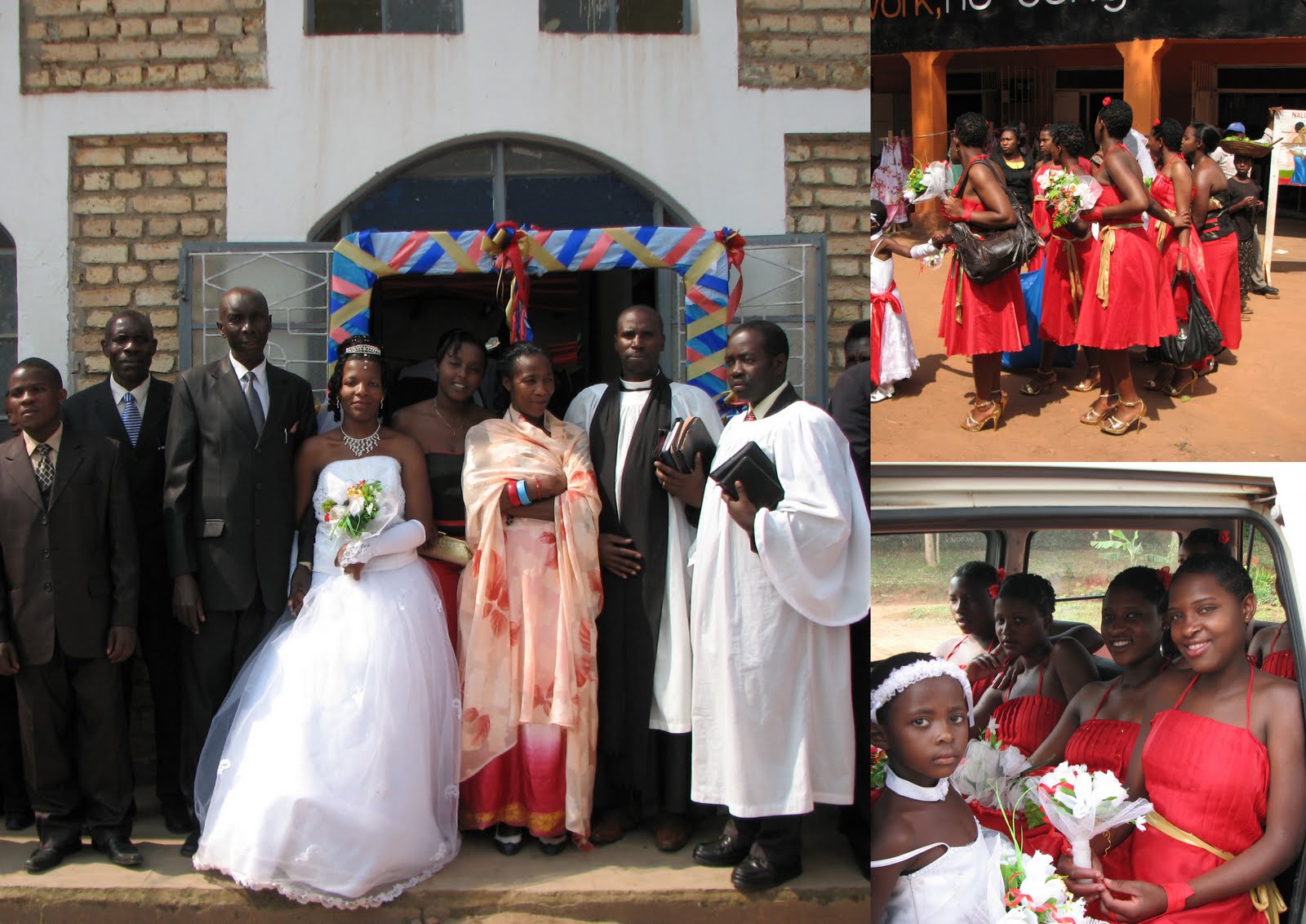
Our neighbour and head of security for BBUC, Benon, married, and I had the honour of being the chauffeur for the bridesmaids.  I loved the stark contrast of their fancy dresses and shoes against the backdrop of Kabale buildings and roads. The wedding itself was very much in the western (Anglican) tradition. The "Give Away," which happens the day before, preserves much more of the tribal culture, and is wonderfully joyful.


July is a celebratory month!  Micah (one of our teammates) had his birthday on July 2, America had her birthday on July 4, Jesse had his birthday on July 10, and we had our anniversary on July 11. The 4th of July was a fun time -- there was something special about remembering the history of our home country while being so far away.  In addition to hamburgers and attempts at fireworks, we also spent time singing, reviewing our constitution and the founding values of our nation, and re-learning how to play baseball!


Jesse turned 11 this year! This guy is growing in humour, intelligence, strength, and good looks. To celebrate, Jesse, Dr. Aaron, Micah and I spent a night on a local island called Bushara. We explored the island, stayed up late watching Legend of the Guardians, canoed out to Punishment Island, swung on rope swings and dropped into the (very) cold lake, and had a devotional and discussion about manhood on the dock at sunrise.  A highlight was the presentation of a flag designed by Jesse and Micah, and brought into existence by Jesse's grandma & grandpa.  (More about that on the kids' blog in a few days.) Another personal highlight for me was getting extended with with Aaron. On the actual Day, we celebrated with the Morrows and a friend named Gracious, eating chicken tacos & chocolate cake on the front porch.
Just this week, BBUC has been celebrating the life of one of their late lecturers, Prof. Joy Kyamunyogonya.  She was the Dean of the Social Work department, and apparently had a passion for cleanliness and concern for the least of those in the community.  In honor of her and in living out BBUC's motto of "Go and Tell Them," BBUC is spending the week imitating these ideals.  On Monday, we marched down Rugarama Hill and spent the morning picking up trash in Kabale.  This is a rare community service in this country, and Kabale is in such need of it! Yesterday we spent the Tuesday chapel hour worshipping God by cleaning up our own campus.  The remainder of this week will be spent visiting local hospitals, the prison, and other communities in need.  Pictured in the centre, by the way, is our Principal, Rev. Prof. Manuel Muranga -- he leads the way in all these events.


Tuesday, June 28, 2011

Village Visits


When we first arrived in Kabale, I would often ask a student or fellow lecturer, "So, where is your home?"  What I meant by the question was, "Where are you currently living?"  Almost invariably the person would gesture toward the distance and reply, "I stay in Kabale, but my home is...," and then would come the name and description of a district and village somewhere many kilometres away.  I quickly learned that the structures where people live here in Kabale -- whether it's a staff house, a hostel, a dorm, or a place in town -- is simply the place where they stay.  "Home" is where they are from, where their family is, where their land is, regardless of how long it has been since they last visited that place.

Here's a similar insight: Back in May our team joined Global Teams missionaries from all over East Africa for a retreat in Kenya.  The retreat was organized by GT's Missionary Caregivers, a group of women lovingly dedicated to pursuing our health and well-being.  The first few days of the retreat we
Kabungo Parish near Bunyonyi. Rev. Hannington's son, Golden,
is a student at BBUC
were with other North American missionaries serving in East Africa, and we spent time studying Scripture, listening to God and to each other. The second part of the retreat about 30 East and Central Africans joined us.  They are GT missionaries as well, with amazing stories of how they are reaching unreached people groups in their areas.  At one point during this part of the retreat, we had a session on cultural differences.  I asked the people in my group, "What does friendship mean in your culture?  How do you know whether someone is a good friend?"  One of the answers that received many nods and vocalizations of affirmation was, "A good friend is one who knows my family.  I mean, this is one who has traveled to my village and met my mother and my father and my sisters and my brothers and my relatives.  One who has been to my home."

So it's not a surprise that we've begun visiting people's homes.  On a Saturday or a Sunday, we pile into our white van and say a prayer.  Then we navigate our way down our hill to the main road, and drive to the local market.  We learned early on that bringing a gift is important to being a good guest, and bringing a branch loaded with matoke (green bananas) is one of the best gifts. Normally we then pick up a guide along the way, the host himself or a friend of the host, who directs us to the turnoff.  Then we bump (and, if it's raining, slide) across red dirt (or mud) roads in between, over, or around hills, past banana plantations and fields of sorgum or beans, through village markets, past countless pedestrians trudging to or from someplace we'll never know.  When we at last reach our destination (sometimes after 30 minutes of driving, sometimes after 6 or 7 hours of driving), we are always warmly welcomed by our host.

Typically, we all sit down for a cup of tea before anything else begins.  Even if a church service where I'm to preach has begun (we can hear the drums beating calling the people to worship), we
must sit down for tea.  First, a child of the host brings water warmed in a teapot and soap, and pours the water over our hands as we wash off the dirt of the road.  Then we enter the house, and sit (or squeeze) around around a table where the tea awaits.  Sometimes there is English tea (water and black tea), African tea (milk and chai), coffee (always a tin of instant Nescafe), sugar, milk, bananas, bread, honey, and g-nuts (peanuts).  Sometimes there is just African tea and a few pieces of bread.  Always there is graciousness and gratefulness, and time to pray and give and receive welcome.

Then the events of the day follow.  If it's a Sunday, all of us are brought to the front of the congregation to sit in full view of the people.  It is a long service of worshipping, singing, preaching (most often me through a translator), more singing, dancing (one of our favorite parts), and communion.  Another one of my favorite parts is the offering.  When the offering basket is brought to the front after being among the people, amid the coins and few bills you will often see a bag of eggs, a small collection of fruit, or other agricultural gifts from folks who did not have money to bring.  I have even seen a goat led to the front and tied to the chancel during the offertory!  Before the service is over, they will auction these gifts off to the congregants, and the money will go to the church, and the food item to the person who bought it.  Often that person will turn around and give what she has bought to the priest or to the visitors.

One other part I love is when I participate in giving communion to the people.  I get to see and touch
these dark, rough, holy hands of people who are so different from me, yet who are my brothers and sisters coming with faith to receive from the One who saves and unites us.  "The body and blood of our Lord Jesus Christ keep and preserve you and you and you and you...unto eternal life."  Old, withered faces with bright eyes; young, strong faces mildly amused at this muzungu priest; tired, sad eyes that won't meet mine; friendly, hopeful faces ready to receive; unreadable faces that stare straight ahead.  The family we are just barely coming to know and love.

After the service comes lunch.  There must be lunch!  Don't even try to excuse yourself from it!  Squeeze in there and be ready to pile your plate high with matoke, "Irish" potatoes, sweet potatoes, goat, beef and/or chicken cooked in a wonderful broth, rice, greens, rolls, liver, intestines, and (once) rabbit.  After you have eaten it all (mostly in silence), be ready for the fruit dessert -- the freshest pineapple, banana, passion fruit and watermelon ever to pass your lips.  Then comes obushera -- this strong, mildly fermented drink that few white people can stomach, but that all Bakiga insist is wonderful and very good for digestion.  Then comes...yes, more tea.

Finally, full of food and welcome, we totter back to the van, often carrying a bag of beans or potatos or vegetables as a parting gift.  We clamber into the van, and begin the journey home.

These visits are both hard and wonderful.  Hard -- we're still learning cultural cues, struggling with
communication due to our lack of Rukiga (the local language) and our hosts' differing uses of English, adapting to new physical circumstances, and eating unusual food.  There is also the challenge of being a young family in these situations; naps are missed, children get tired, they get hungry (although we're impressed with what great eaters of Ugandan food they have become!), places that feel safe to our hosts sometimes seem dangerous to us; I get a lot of attention and am often involved with services or interacting with people while Leslie is left alone to care for the kids.

Wonderful -- the hospitality is unceasing.  Our hosts and their community consistently receive us with genuine excitement, unending hand-shakes, hugs, gifts, kind words, and food.  We learn more of Bakiga culture in a few hours in the village than days in our house on our hill above town.  We get to see a way of life that reveals both the beauty and challenge of the simpler, poorer life away from town.  The geographical beauty is often stunning.  We experience the humbling joy of being hosted by people who know how to love a lot with so very little.  And we become friends with the people we're learning to love, knowing them in their home.


(Here are a few more photos from our visit to Canon Jovahn's home, pictured above, Deputy Principal of BBUC.  By the way -- in case you don't know, you can click on any of the pictures in our blog and see a larger, clearer version.)


Monday, June 20, 2011

Caring and Careful Wisdom

As you read in my previous post, obviously I enjoyed the importance of tea in the meeting of the Scholarship Committee.  I was even more impressed by the caring and careful wisdom of the men and women on this committee.  We interviewed candidates from a number of backgrounds and current situations, all of them rather dire by western standards.  We had the expected criteria -- academic performance, experience, vision, spirituality, etc., plus a scoring system to aid in the decision making process.  Here is what impressed me:

Me with Canon Jovahn, Deputy Principal of BBUC
and Chair of the Scholarship Committee
(yes, having tea!)
  • My colleagues did not hesitate to ask piercing and probing questions.  I squirmed more than once during the interviews (as did the candidates), but clarity came from such honest questions.
  • The people mattered far more than the process, and "people" meant far more than the just the candidate we were interviewing.  The questions and discussion explored how awarding a scholarship to an individual would in fact affect their family and their community.
  • My colleagues' dialogue was insightful, humble, and responsive.  They listen to each other.  The conversation is formal, polite, and often firm, but minds and hearts change submit and change as the discussion continues.
  • They are always ready to stop, pray, and listen before making decisions.
I actually have learned more about Ugandan cultures, my colleagues, and my students in these meetings than in many other situations.  No surprise, of course, but working together reveals even more than observing and asking questions. I have also been grateful for how willing they are to listen to my thoughts and ideas, even though I'm an outsider and newcomer.

By the way, if any reading this blog would be interested in providing a scholarship for one or more students studying at BBUC, please contact me directly at hinesfamily@gmail.com.  The need is great, and I am now witness to (and participant in) the fact that the scholarships are faithfully and prayerfully given with consistent integrity.

Lecturers and Administrators of BBUC

Thursday, June 16, 2011

To Tea or not to Tea...

...that was the question!  We were almost an hour into our Scholarship Committee meeting, and the g-nuts (peanuts), bananas, mugs, and thermoses of tea sat waiting on the table.

I have learned several important lessons about tea time in Uganda.  First, no one wants to miss tea.  (It took me half a term to realize the reason students are anxious for a timely end to my morning classes is so they won't miss morning tea.)  Second, one rarely conducts business over tea.  Third, skipping tea is not an option.

So what were we going to do?  It was time to interview the applicants, and in only 45 minutes the church service was to begin.  The politely formal yet earnest discussion began.
"We cannot have our tea while we interview the candidates.  We must take it now."
"But we should not keep them waiting.  Why not have the tea after the interviews?"
"It will be time for the service. Why not have it after the service as our lunch?"
"This we cannot do! Tea for lunch?!"
"Chairman, some of us may not have eaten breakfast in anticipation of this tea.  What of them?"
After about ten minutes of discussion, we settled on permitting the hungry to discreetly munch on g-nuts while we conducted the interviews, and having tea immediately after.

Fast-forward thirty minutes.  We can hear the music of the service beginning.  Two candidates remain, waiting to be interviewed, and the tea remains to be taken.  The earnest discussion begins again, not without a good measure of humor.
"Chairman, I would like to submit that we now take our tea, and interview the remaining candidates after the service."
"I second the proposal."
"But the service is beginning!  Do we have time?"
"If we hurry."
"Take tea in a hurry?!  How could this be?"
"Perhaps we could not take the tea."
"Would you have us not take tea?" 
(Quiet, shared incredulity.)
"Let us have tea."
The two waiting candidates were invited to join us for tea, while those with responsibilities quickly enjoyed their tea and slipped out.  The rest of us unhurriedly sipped our African tea (hot milk and chai) or English tea (hot water, milk, and black tea), ate our bananas and nuts, then entered the service to join in the singing and dancing.


(Next: While obviously I enjoyed the importance of tea in this meeting, I was even more impressed by the caring and careful wisdom of the men and women....)

Friday, June 03, 2011

Ugandan Martyrs


 On 3 June 1886, thirty-two young men, pages of the court of King Mwanga of Buganda, were burned to death at Namugongo for their refusal to renounce Christianity. In the following months many other Christians throughout the country died by spear or fire for their faith.

 These martyrdoms totally changed the dynamic of Christian growth in Uganda. Introduced by a handful of Anglican and Roman missionaries after 1877, the Christian faith had been preached only to the immediate members of the court, by order of King Mutesa. His successor, Mwanga, became increasingly angry as he realized that the first converts put loyalty to Christ above the traditional loyalty to the king. Martyrdoms began in 1885. Mwanga first forbade anyone to go near a Christian mission on pain of death, but finding himself unable to cool the ardor of the converts, resolved to wipe out Christianity. 


The Namugongo martyrdoms produced a result entirely opposite to Mwanga’s intentions. The example of these martyrs, who walked to their deaths singing hymns and praying for their enemies, so inspired many of the bystanders that they began to seek instruction from the remaining Christians. Within a few years the original handful of converts had multiplied many times and spread far beyond the court. The martyrs had left the indelible impression that Christianity was truly African, not simply a white man’s religion. Most of the missionary work was carried out by Africans rather than by white missionaries, and Christianity spread steadily. 

Renewed persecution of Christians in the 1970’s by the military dictatorship of Idi Amin proved the vitality of the example of the Namugongo martyrs. Among the thousands of new martyrs, both Anglican and Roman, was Janani Luwum, Archbishop of the (Anglican) Church of Uganda.  


PRAYER
O God, by whose providence the blood of the martyrs is the seed of the Church: Grant that we who remember before thee the blessed martyrs of Uganda, may, like them, be steadfast in our faith in Jesus Christ, to whom they gave obedience even unto death, and by their sacrifice brought forth a plentiful harvest; through Jesus Christ our Lord, who liveth and reigneth with thee and the Holy Spirit, one God, for ever and ever. 

(I found this helpful summary at The Hanscom Family Weblog.)